My name is Anna Lima. I am the daughter of immigrants, born and raised in Massachusetts. I am the mother of two and a Speech Pathologist. My love of family history began as a child listening to my elders speak of “the old country”. Through their stories grew a love for the culture and traditions of my ancestors and I wanted to know more about who they were. My great-grandmother, our family Griot, was my greatest inspiration as she passed down stories and traditions that have helped me become the person I am today. I believe that remembering our ancestors strengthens who we are. I hope to continue my great-grandmother’s legacy, to continue to pass down the stories of not only my own family history but also the stories of the ancestors of anyone who wishes to remember. My blog is dedicated to the ancestors, those remembered and those yet to be found.
The morna is synonymous with the concept of Caboverdeanidade. The melancholic melodies and lyrics full of sodade has captured the essence of our culture for at least two centuries. Some might describe the Morna as a musical form that expresses the sadness and isolation of our people but I’ve never perceived it that way.
The Morna is about “Sodade” which is defined as a “nostalgic longing to be near again to something or someone that is distant, or that has been loved and then lost”. But it also about “the love that remains”. For me, Morna is exactly that. One of my favorites, “Nos Morna” by Ildo Lobo, says the Morna is the “inspiration of our poets, the princess of our serenades, on a quiet moonlit night, under the window of your love, and the quiet cry of my violin”. Cabo Verde without Morna would be “a land with sun, without heat, a bride without lace, victory without glory”.
The Morna is truly who and what we are.
The love for the country and culture of our ancestors is ingrained in my DNA. That love has remained and been passed down through generations of Cape Verdeans in Cabo Verde and throughout the diaspora, alike. The melancholic tunes immediately triggers the same reaction in me today as it probably did in my ancestors in the 1860’s when the oldest known morna, Brada Maria – Composed by Jose Bernardo Alfama and lyrics added later by Eugenio Tavares, was penned.
Our cousin, António Germano Lima, professor at the University of Cabo Verde, has written that the origin of the Morna is the “Lundum”, music of the Bantu people that spread from Angola to most of West Africa. It is believed it that was brought to Cape Verde by enslaved Africans to the island Boa Vista.
The Lundum has been preserved in Boa Vista and is traditionally heard during wedding festivities as the bride groom dance for the first time as a couple.
Musicologists point out the connection and relationship of the music of Cape Verde and Brazil, especially as it pertains to Lundum. Today, it is taught and celebrated among descendants of enslaved Africans in Bahia, the northern part of Brazil. Lundum em Belem do Para
The essence of our Caboverdeanidade, the thing that makes us who we are, is difficult to put in words so our ancestors put it to music.
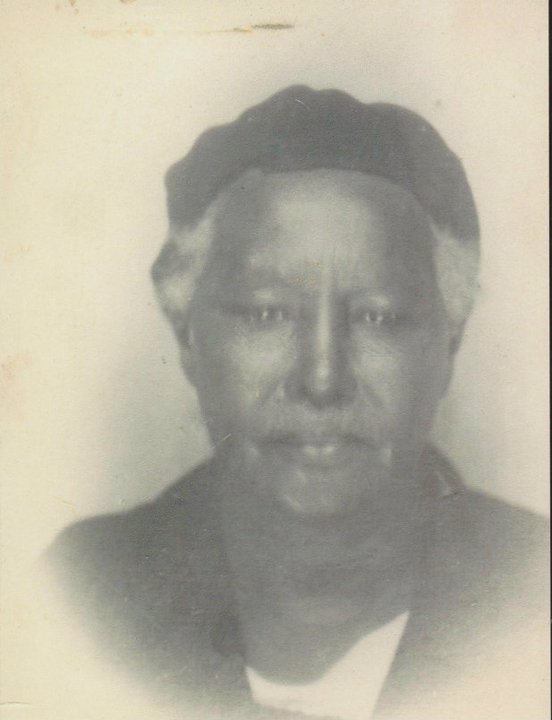
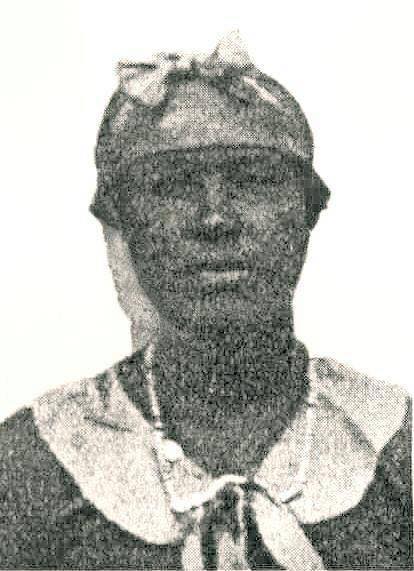
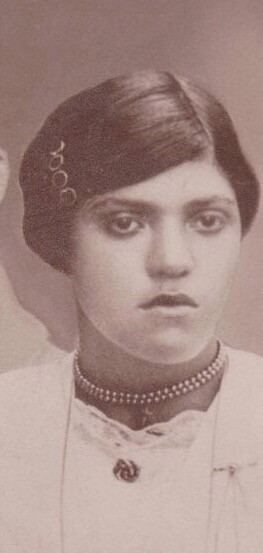
Some time ago, I posted a picture on FaceBook entitled “Retrato de Duas Mulheres” which features two very striking women and got a lot of attention. Most asked who these women were. At the time I had no idea. I was mostly focused on what I’ve come to call the “Lima Nose”. These women had the same nose as my great grandmother, Joanna, and her family member, Padre Manuel Antonio de Brito Lima.
Duas Mulheres – Boa Vista, 1926My Great Grandmother, Joana Fortes Lima Gomes – Born in 1876 in Rabil, Boa Vista
Many people reposted this picture and it finally got to a woman in Boa Vista, Joana Lima Ramos, who identified the two as Maria Barbara and Nha Luci! When I inquired, she was, in fact, referring to Maria Barba, a very well known singer from the island of Boa Vista who, at the height of her career, performed at the Exposiçao Colonial do Porto in 1934 in Portugal.
The only picture I had ever seen of this woman was a fuzzy image that didn’t show her remarkable features. She was young when she married and had her first child in 1930. The picture I posted was from 1926!
Maria Barba
Maria Barba was born in 1910 in Boa Vista and died in 1974. Musicians made famous a song called “Maria Barba” about this very same woman. I grew up hearing this song and I am honored to get a closer glimpse of this woman from the island of my Lima ancestors.
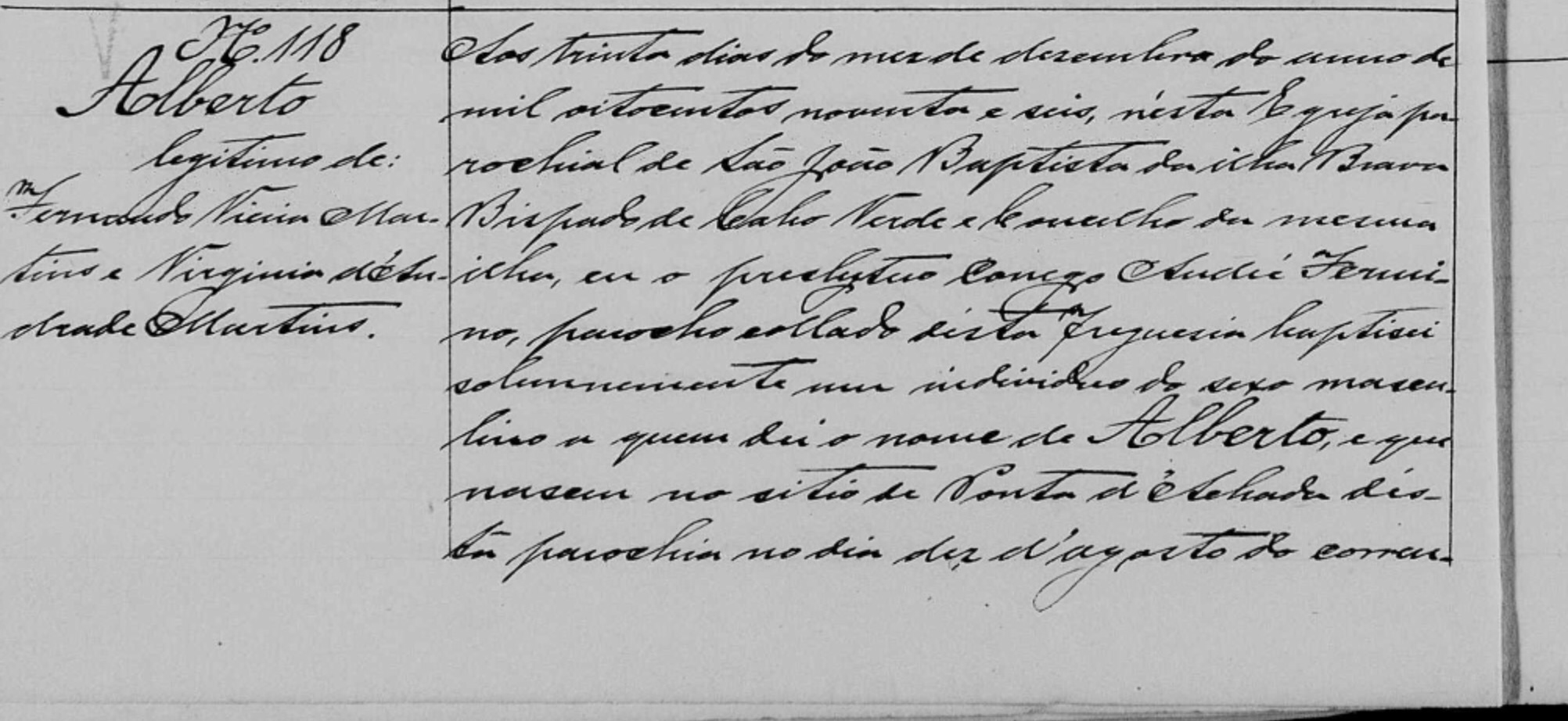
In my previous post, Bibi Had A Secret, I mentioned that I hadn’t been able to find and “Alberto” in vital records from Brava… Until now!!!!
I think I found Alberto!!!!
This Alberto was born in 1896 in Ponta Achada, Sao Joao Baptista to Fernando Vieira Martins and Virginia d’Andrade Martins. His paternal grandparents were Boaventura Martins and Palmira de Abreu Vieira Martins and his maternal grandparents were Jose Lourenco d’Andrade and Rosa Pires, natives of the parish of Sao Nicolao, Lisbon.
It may be a long shot but this is the first record I have come across for an Alberto. Hmmmm!
A few years ago, I was interviewed by a reporter from a Cape Verdean radio show. He asked me who I was and who my family was. Before I could filter what came out of my mouth, I said, I’m Nanie de Ramizi de Rosinha de Nha Maria Rosinha de Cham de Souza! In one breath, I had given him 5 generations of my family history in Cham de Sousa, Nossa Senhora do Monte, Brava. While I’m sure he would have been satisfied with my first and last name, I merely answered the question as I have heard many Cape Verdeans respond to the same question growing up in Massachusetts.
We joke about the fact the most Cape Verdeans don’t know each other’s official names. I can’t begin to tell you how many times I have sat down to interview a family member and was given names like “Ma Lina Nha Sena”, “Lota de Nha Tansha”, “Genio Culung” and “Genia de Neka”. My own grandmother went by Matitita. I have cousins named Maria Lora, Maria Fidjinha, Maria Meninha and Maria Bia who are all “Maria” and are identified by their mothers, Laura, Virginia (Fidjinha), Meninha, and Bia. Then there’s Mane Bia, Mane Candia and Mane Creola, all family members named Manuel whose mothers were Bia, Candida, and … Well, I have no idea who “Creola” was, lol! Try finding these people in vital records where everyone is literally named Maria, Gertrudes, Manuel, Jose and Joao… Well, It might just be easier finding that needle in a haystack!
Naming conventions or naming traditions in Cape Verde can be a little tricky to navigate. Like many Portuguese “rules”, a first son may be named after the father’s father and the first daughter named after the mother’s mother. More often than not names were recycled in almost every generation! Middle names were often used by both men and women to identify which branch of the family they belonged. In my Coelho tree, Jose was the middle name given to all the sons and daughters of Jose Coelho. Not be confused with children of his brother Joao who also used the middle name Joao and sometimes Jose. Maria is also a common middle name for men, ie, Jose Maria Feijoo. There’s also the mysterious changing middle name. Marcelino Antonio Coelho was also Marcelino Jose Coelho.
The key is to understand how nicknames are used. When I tell people that I am Nanie de Jose de Sevala de Nha Nuka de Nha Tila de Nho Mane Valentina… lol… what I’m actually saying is that I’m the daughter of Jose, son of Sevala who was the daughter of Nha Nuka (Anna) who was the daughter of Nha Tila (Matilda), daughter of Manuel, son of Valentina. As you can see, the use of nicknames go from the fairly understandable.. Mane is short for Manuel to the inexplicable, Nuka for Anna. But when you see these patterns, the job of figuring of which “Manuel” you’re looking for in genealogy records becomes easier when you know that he was the son of Valentina. In my case, I had been looking for a Manuel dos Santos born around 1830 and knew I had the right one when I found a Manuel, son of Antonio dos Santos and Valentina de Burgo.
I think this is one tradition we should continue. People do refer to my children as “Nia de Nanie de Ramizi” or “Tyson de Nanie de Ramizi”. It will help later generations trace their trees much easier. Knowing that my Great-grandmother was known as Maria Rosinha made it easier to find records for her mother, Rosa.
So my real name is… Nanie de Ramizi de Rosinha de Nha Maria Rosinha de Cham de Sousa … AND… Nanie de Jose de Sevala de Nha Nuka de Ma Tila de Nho Mane Valentina… It’s also Nanie de Jose de Popinho de Nho Djedje de Relva. But you can call me Anna, Nanie or even the Creola Genealogist 😊
Ask anyone who has spent many hours painstakingly sifting through baptism, marriage and obituary records and they will tell you that it is a labor of love. We will admit that its tedious at best but it’s completely worth it to find the one gem in a sea of minutiae of awful handwriting and abbreviations that make no sense. And when the awful handwriting and nonsensical abbreviations are in a different language… well you might begin to understand why we may not always want to just give away what we worked so hard to find.
I recently found a marriage record for my great-great-great-great-great grandparents, Manuel da Lomba and Dorothea de Burgo, who were married on April 4, 1816 in the Sao Joao Baptista in Brava. Manuel’s parents were Antonio da Lomba and Rosa Rodrigues and Dorothea’s were Nicolao de Burgo and Maria de Andrade Gilmete. From this record, I now had the names of MY great-great-great-great-great-great grandparents! Its such a great feeling to be able to go back one more generation.
But when you really think about it, I had just found the names of the great x6 grandparents for thousands of people. These people don’t just belong to me. No matter how much I would like to believe that my tree only belongs to me because I am the one doing the research, the reality is that it belongs to all the descendants of these people. I don’t own my ancestors.
It’s this idea that makes me share my research and my ancestors with others. I hope that what I’ve been able to uncover will inspire others to expand this tree or work on their own. The best feeling is being contacted by someone who has found one of my blog posts and tells me that they are a descendant of that person and they want to know more about the family and the culture. Helping people connect with their Cape Verdean roots is just as gratifying as finding the names of an elusive ancestor.
But most importantly, these are stories about our ancestors in their own words through records that date back to the early 1800’s. We have been accustomed to other people telling us about who and what WE are. So with this in mind, I will continue to “share” my ancestors and I will tell their stories in hopes of creating a new narrative of what it means to be a Cape Verdean in their own words.
About five years ago, I became a volunteer at the local Family History Center at the Mormon Church located in Annapolis, MD.
YES, you read it correctly, I spent many Saturday mornings and occasional evenings during the week at a Mormon Church just so I could get direct access to genealogical records! When I first learned the Mormon Church had archived Church records for each of the islands in Cape Verde and the only place I could see them was at the Center I did what any logical genealogist would do to get unfettered access.
I spent countless hours ordering then scanning each record for the islands of Brava, Fogo and Boa Vista. I felt like the luckiest person in the world armed with quite a few flash drives painstakingly filled with baptism, marriage and obituary records of my ancestors. Life was good. But now it’s gotten better!
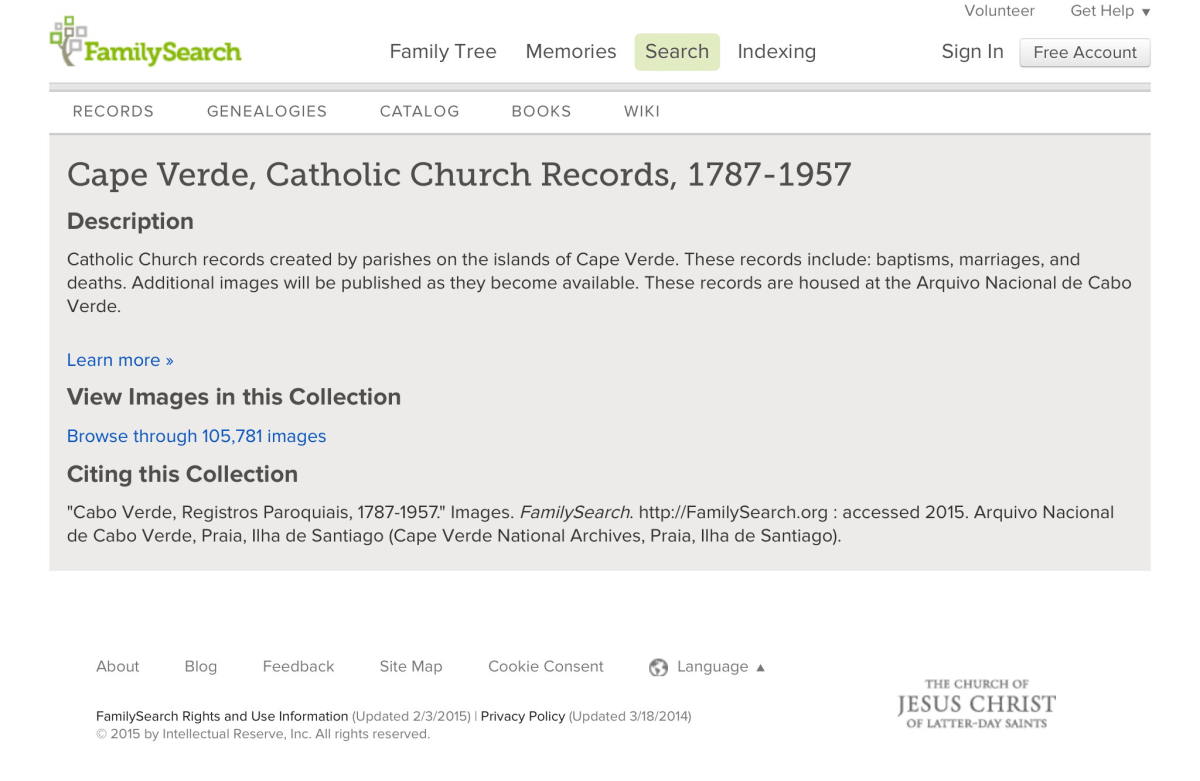
Had I known that one day ALL of the records would be available online I could have saved some money and spent my Saturday’s doing something a bit more exciting. Now anyone can have access to these vital records though the Family Search website available through the Mormon church.
Once you have been able to determine who and when your ancestor came to America, their immigration and/or naturalization records should include native island and sometime town name. It may also include parent names and the name of a relative who still lived in CV at the time of their migration to the United States.
The search feature on the FamilySearch page is only useful for records from Santiago at this time. To view the records for all the islands, scroll to the bottom of the page to the link “Browse through 105, 781 images”. Don’t let the number scare you! The records are sorted by island, parish and then date ranges.
The only spanking my great-grandmother, Bibi, ever got from her father was when she refused to go to the cemetery to put flowers on the grave of her sister, Clara. She said that her father told her that she shouldn’t be afraid to go there because sooner or later we would all end up there. But it wasn’t fear that made her refuse. It was because the cemetery was located on a mountain in Nossa Senhora do Monte named after her great-great grandmother, “Nha Leandra”.
When someone passed and was buried at this cemetery, someone would inevitably recite something like;
“Aye, Nha Leandra! Dja bu toma’m nha mae!” (Aye, Nha Leandra! You’ve taken my mother!)
Bibi just hated the fact that people said that her ancestor had taken their loved one! I don’t really blame her for taking the risk of a spanking to avoid visiting a place associated with such sadness and knowing you have a more personal connection with its namesake.
Of course, being the genealogy sleuth that I am, I had to find out who Nha Leandra was and why she had a mountain named after her.
Leandra Pereira Dias
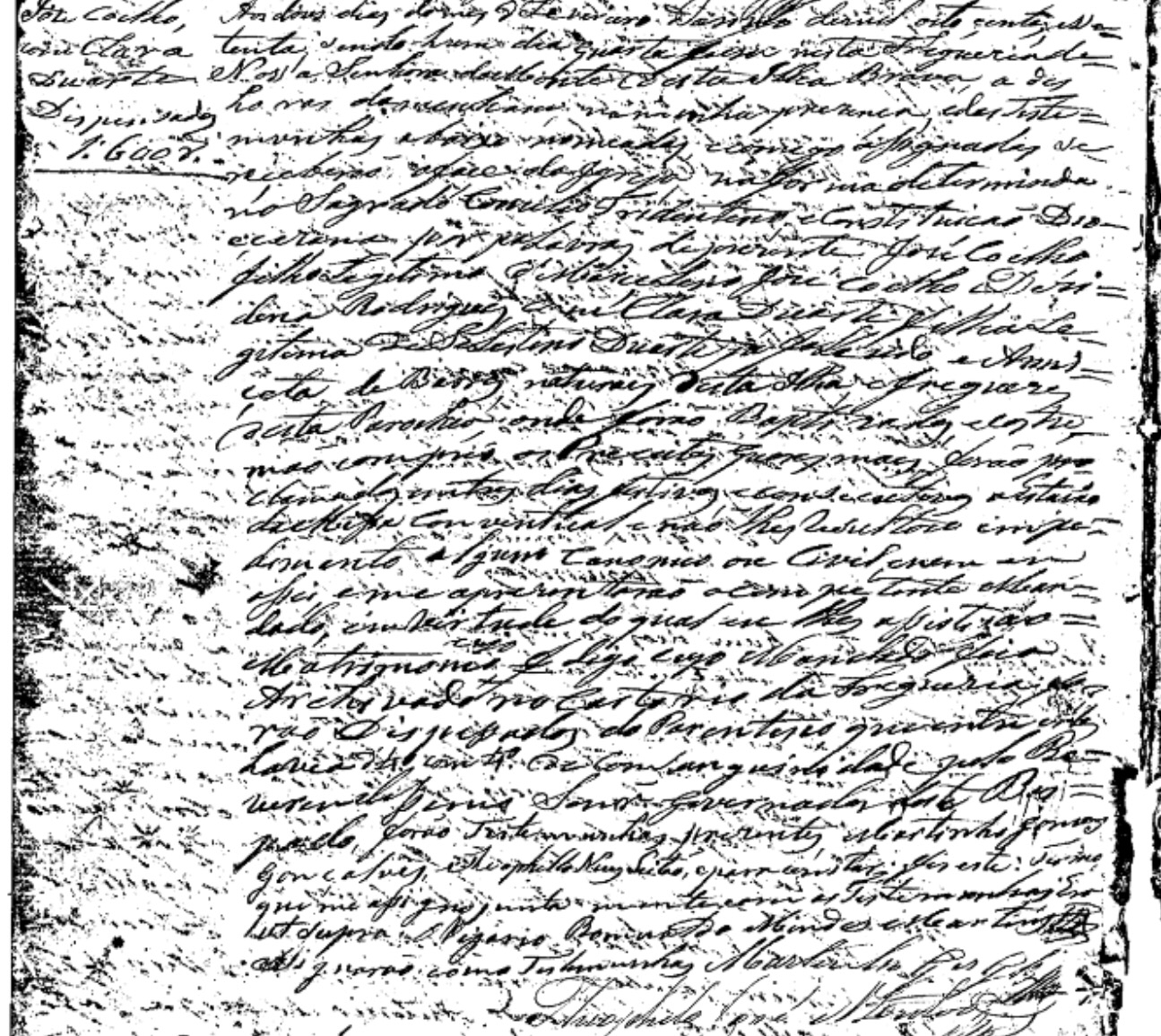
On December 29, 1811, in the church of São João Baptista in Brava, Joaquim de Barros son of Antonio de Barros and his wife, Maria Pires, married Leandra Pereira, daughter of Angelo Dias and Maria Pereira.
My great-great-great-great-great grandparents received a special dispensation by the Bishop of Cape Verde to marry since they shared the same great-great grandparents. In older marriage records, such marriages included a notation such as ” forão dispensado a 4 com 4 grãos de consanguinidade”. There were 4 “degrees” of separation between each of my great x5 grandparents and their common ancestor. Siblings are 1 degree removed from their parents, first cousins have 2 degrees of separation from their common grandparents, second cousins or first cousins once removed have 3 degrees of separation, etc.
Joaquim’s father, Antonio de Barros, left one of the largest wills known to exist in the national archives of Cape Verde. It contains over 650 pages and contains information that includes ownership vast amounts of land in Brava and how it was devided between his heirs. The will also includes information of slaves the family may have owned and probably freed after he died. It was customary in Cape Verde that any enslaved people were to be freed after their master died. I hope this was the case for my great x6 grandfather. I have not been able to actually read this will as I am still waiting for special permission to receive a copy after proving my descendancy.
This may help to explain how Leandra came to have a whole mountain named after her. In baptism records for her grandchildren, Leandra is listed as the sole grandparent listed without Joaquim which means that he probably died young. I have not seen any information that said women didn’t inherit from the husbands. It is safe to assume that Leandra would have been left with any land and property from her husband.
GENERATION 1
Joaquim and Leandra had five children that I have been able to find so far;
1. Manuel de Barros (b. 1816- d. 1891)
2. Joanna de Barros (b. April 8, 1825)
3. Alexandrina de Barros
4. Anna de Barros (b. 1816- d. 1889)
5. * Aniceta de Barros married Celestino Duarte, son of Zacharias Duarte and Isabel de Barros.
GENERATION 2
Aniceta was known as “Nha Nicetra de Leandra”. Celestino and Nha Nicetra had at least 12 children, including my great-great grandmother, Clara de Nha Nicetra. I have only found records for 8 of the 12 children.
1. Catherina Duarte married to Antonio Jose Lopes
2. Julia Duarte married to Antonio Tavares, child – Eugenia Tavares ( Jania de Neka)
3. Manuel Duarte married to Maria Pires do Livramento, child – Joaquim Manuel Duarte
4. Carlotta Duarte (b. 1847)
5. Joao Duarte (b. February 20, 1845)
6. Emilia Duarte married to Joaquim Rodrigues
7. Eugenia Duarte married to Jose Tavares da Silva
8. * Clara Duarte married to Jose Coelho (b. 1845) , son of Marcelino Jose Coelho and Desidaria Rodrigues.
GENERATION 3
Clara Duarte married Jose Coelho on February 12, 1870 which fell on a Wednesday. Their marriage also received special dispensation by the Bishop of Cape Verde as they shared great-great grandparents. They had at least 9 children;
1. Adelia married to Augusto Jose Fonseca
2. Henrique Jose Coelho (b. 1870) aka Henry Rodgers married to Margarida Duarte
3. Joao Jose Coelho (b. 1871) married to Maria Ozorio
4. Carlotta Coelho (b. July 2, 1873)
5. Julia Coelho (b. 1878) married to Francisco Jose da Lomba, children – Maria and Jose
6. Maria Coelho “Ma Mulatta” married to Joaquim da Costa – children Joao, Arminda, Clara and Carlotta (twins)
7. Manuel Jose Coelho (b. June 15, 1881) married to Mariana Jose Coelho
8. Luis Jose Coelho (b. October 7, 1887) married to Amelia Tavares
9. * Antonio Jose Coelho (b. 1879-1918) married to Rosa da Lomba Goncalves (1886-1918), daughter of Julio Goncalves and Carolina Correia da Lomba.
GENERATION 4
My great-great grandparents, Antonio and Rosa, lived in Tome Barraz and had four children;
1. Julio Antonio Coelho (b. 1908 – d. 1971) married to Rovilla Fern Youle, children – Myrtle and Rose Coelho and their descendants live in Northern California
2. Carolina Coelho (b. 1912 – d. 1998) married Joao dos Santos, children Antonio, Joaquim, Arthur, Irene and Idilia dos Santos and their descendants live in Cape Verde, California, Massachusetts and Rhode Island
3. Clara Coelho (b. Unknown)
4. * Maria “Bibi” Coelho (b. 1904- d. 2003) married to Avelino Rodrigues (b. 1900 – d. 1929), had one daughter Rosa Rodrigues (b. 1923 – d. 2003) married to Raimundo Fortes Lima, son of Marcelino Teofilo Rodrigues and Joanna Fortes Ramos Lima (b. 1876 – d. 1961). Their descendants live in Massachusetts … Except for one who lives in Maryand and calls herself the Creola Genealogist 😃.
I recently posted this on the Azores genealogy group on Facebook
To which I got this reply,
Doug had found a baptism record for Francisco who was born in April 10, 1799 in Quatro Ribeiras in the parish of Santa Beatris, Terceira. Franisco was the son of Jacinto Coelho de Mello and Joaquina Luiza, who was a natural of Biscoitos, in the parish of Sao Pedro. Francisco’s paternal grandparents were Joam Coelho de Mello and Francisca Marianna and his maternal grandparents were Joam Machado da Rosa and Agostinha da Rosa.
I am only beginning my research of records from the Azores but I have found that the Coelho’s were among the first families to settle in the Azores and the island of Terceira, specifically. There are two branches of the family, descendants of Joao Coelho and Luis Afonso Coelho.
The donatorio, Jácome de Bruges, gave land to these first families. João Coelho was given Porto Judeu.
João Coelho married Catherine Rodrigues da Costa in 1456 , after her husband settled in Porto Judeu . They had the following children:
1 – Salvador Coelho, who was married to D. Catarina Martins.
2 – Baltazar Coelho, who married twice, the first with Dona Ana Cabeceiras and the second with D. Violame of Valadão.
3 – Gaspar Coelho married Violante Nunes.
4 – António Coelho, married in Angra do Heroismo with F. Mourato.
5 – Fernao Coelho, who died as a child.
6 – Bartolomeu Coelho, married in Belo Jardim, Victoria Beach Agnes Bridge.
7 – Francisco Coelho, married Maria de Barros.
8 – Margarida Coelho also married Diogo da Ponte.
9 – Nicolau Coelho.
Francisco, Antonio and Nicolau are all common first names in my Coelho family tree.
My great-grandmother, Maria Coelho, affectionately known as Bibi, was one of the most pious women I have ever known. She was a devout Catholic and had a moral compass that was unparalleled. There was no in between with her. You were either right or you were wrong. She demanded that you treat yourself with respect and that you carried yourself with the utmost propriety. In the 30 years that I had the honor of knowing her, I am convinced that she never did anything wrong.
In 1998, Bibi suffered a major stroke. That morning, Vovo, my grandmother, called me to come over and help her with Bibi because she just wasn’t acting right. I was in grad school at the time studying to become a Speech and Language Pathologist and I immediately recognized that she was having a stroke. While she was still able to speak, it wasn’t making much sense. We got her to the ER and I’m with her as the Dr was checking her out. He asked if she spoke any English. I said “No”. Of course, Bibi looks at him and says “Dr, Nobody’s home!”… In perfect English!!!
I had studied in class certain phenomenon that happened with a persons language skills after a stroke, like forgetting their native language and only speaking a second language. So at that point, Bibi had started to speak only English. I had NEVER heard Bibi speak English in my life. There I was worried about my 94 year old great grandmother suffering a major stroke and I’m giggling in the ER in shear disbelief over what I just heard!
By the end of that day, she was stable but not speaking … In Criolu or English. I spent the night with her after and was with her when she woke up the next morning. I asked her how she was and she looked at me and said “Alberto”. Every time she opened her mouth to speak, she said “Alberto”. All I kept thinking was “Who in the world is Alberto?”.
Nobody knew who Alberto was. No one had even ever heard Bibi mention Alberto. Her husband’s name was Avelino. So who was Alberto and why was that the only thing she could say????
To make matters worse, a social worker visited my great-grandmother in the hospital to have some paperwork done regarding a Medical Power of Attorney, etc. She apparently asked Bibi who she wanted to handle her medical decisions and Bibi responded “Alberto”. So later that day, I arrived at the hospital and asked a nurse about Bibi’s condition and she told me she couldn’t talk to anyone except “Alberto”!!!!
Needless to say, I caused a bit of a ruckus and made sure everyone understood that she had Aphasia and could ONLY say that one word.
Bibi’s speech eventually came back and she was back to her normal self in no time. At 94, she wasn’t about to let a little stroke keep her from going back to being our family matriarch. One day, I asked her who “Alberto” was. She never responded but gave me that look that meant I better not ask again if I valued my life.
To this day, every time I look at vital records from Cape Verde, I’m always keeping an eye out for someone named Alberto who almost became my Great Grandmother’s Medical Power of Attorney 🙂
In 1905, my great-great grandfather, Sebastiao Fortes traveled to America with a daughter Silvania Fortes. Until now, I had not known of this sibling of my great-grandmother, Anna. When I first found this record, I immediately set out to find more information about this unknown ancestor. I had to know who she was.
I was on a quest to find Sylvania.
Silvania was born around 1877 or 1878 and was the daughter of Sebastiao Correia Fortes Ramos and Hermelinda d’Andrade dos Santos. My great-great grandparents were married on March 18, 1871 in the Church of Nossa Senhora do Monte, Brava. Sebastiao was the son of Osvaldo Fortes, native of the island of Boa Vista, and Anna Correia. Hermelinda was the daughter of Manuel Antonio do Santos and Domingas d’Andrade who are noted to be the first parishioners of the Parish of Nossa Senhora do Monte.
Marriage record of Sebastiao Fortes Ramos and Hermelinda dos Santos on March 18, 1871 in Nossa Senhora do Monte, BravaSebastiao Fortes Ramos
Hermelinda, was known as Nha Tilda, and her paternal grandparents were Antonio dos Santos and Valentina de Burgo. Family lore says that Antonio was from Braga (Portugal). Her maternal grandparents were Manuel d’Andrade and Escolastica de Barros. Given the time frame and the surnames, I am guessing that her maternal grandparents were from the island of Fogo. Sebastiao was born in 1847 and Nha Tilda was said to be much older. She may have been married before and had other children.
According to the immigration record of 1905, Sebastiao had come to America for the first time 30 years before in 1866 and was last in America in 1903. He would have probably come on a whaling ship in the earlier days and it has been quite difficult locating any of those records. Sylvania is listed as being 27 years old when she arrived with her father.
Sebastiao and Sylvania coming to America in 1905
By 1910, Sylvania is listed as working as a servant in a boarding house on 73 Joy St in Boston, MA. The boarding house belonged to Antonio Hypolito Brito and his wife, Theodora Fortes Ramos! At this point I’m convinced that there’s a family connection between Theodora and Sebastiao!
In 1915, Sylania marries Joao Fortes Lima, native of Boa Vista. The marriage is his first and her 2nd. Turns out that Sylvania was married before in Brava and has a daughter in 1905, shortly before coming to America.
Marriage of Silvania and Joao F. Lima on January 12, 1915 in the city of Boston, MA
In 1921, Sylvania is listed as traveling from Brava to Massachusetts with Maria Fortes, age 14. Sylvania is 44 when she arrives and the record reports that they are going to live with Sylvania’s daughter, Olivia Fortes Almeida, and Maria is Olivia’s daughter.
While I suppose it’s possible, this would mean that Sylvania became a grandmother when she was 30 years old. Olivia Fortes Almeida was born in 1901 in Brava and is listed in a 1917 immigration record as being the daughter of Carlotta Fortes, Sylvania’s sister. It’s a possibility that this is the daughter she had with her first husband in Brava. In all other records and family stories, Olivia Fortes Almeida is listed as Sylvania’s daughter.
The last piece of information I found for Sylvania is of her being in a hospital in Boston in the 1940 census. What became of her is unknown but through contact with some of her descendants, I hope to learn more about her. What became of her second husband Joao? What happened to Maria and Carlotta? I have been able to find out that her daughter, Olivia, married Candido Almeida and had several children, including Mildred Almeida, who became Miss Massachusetts in 1951.
When researching ancestors, it’s difficult not to imagine how they lived their lives. You become vested in their lives. Were they happy? Did they suffer? While I still have some questions about what happened to Sylvania, seeing that her descendants went on to be successful and even become Miss Massachusetts makes me feel a little better.
This site features a genealogy blog about the Ville Platte Louisiana area African descendant families of Frank, Jason, Denton, Ruben, Leday, Laughtin, Joseph













 The Creola Genealogist